

Ontario’s attorney general says a landmark case before the Supreme Court of Canada could reshape the country’s constitutional balance for generations, and is asking judges to resist calls to limit the use of the notwithstanding clause.
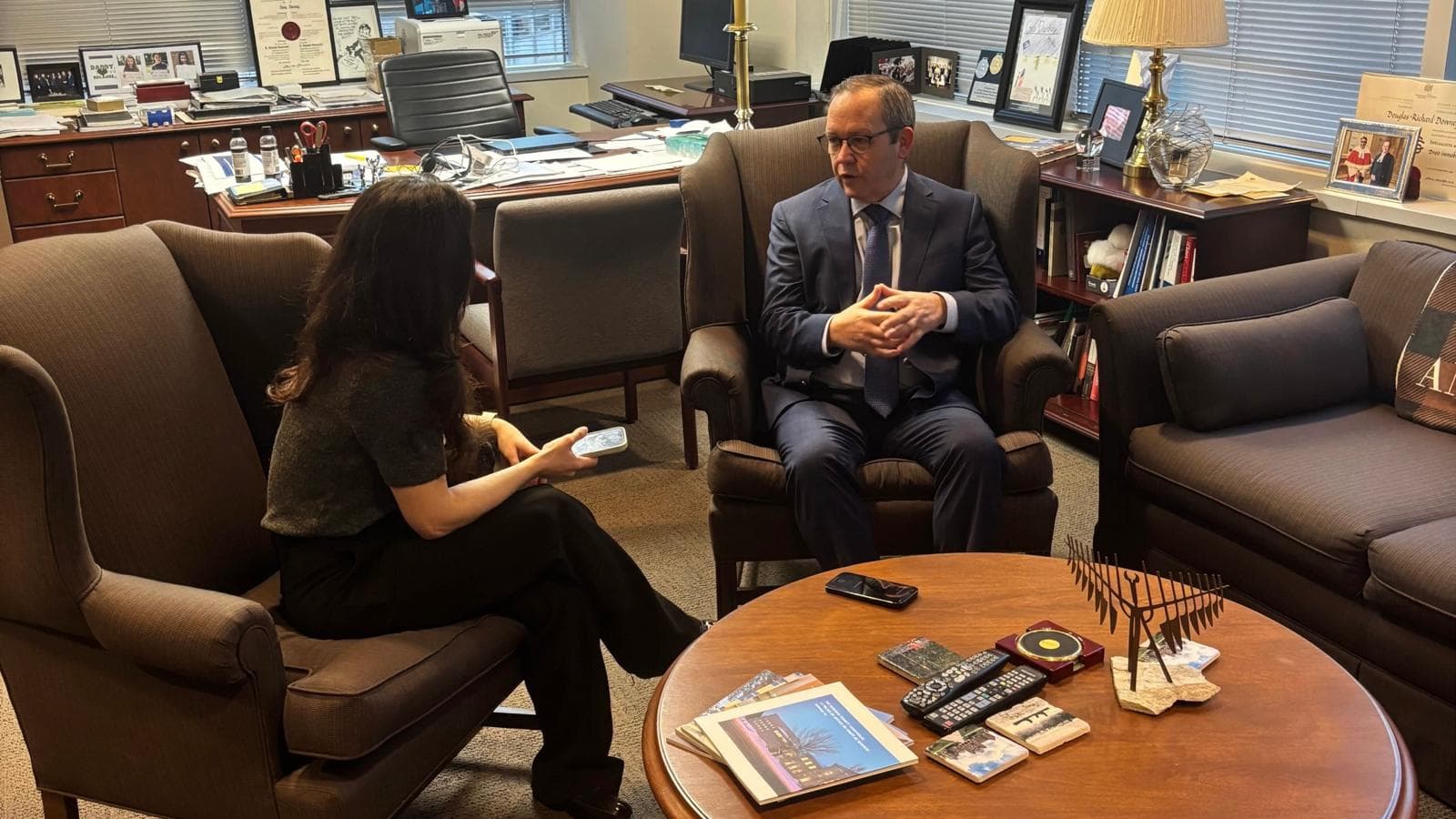
In an exclusive interview with QP Briefing following his rare personal appearance before the court, Attorney General Doug Downey framed the high-stakes hearing as a defining moment for Canada, centred on who ultimately has the final say on Charter rights: courts or elected governments.
“This is a case of profound significance… for the entire federation,” Downey said. “It really is about the balancing act between the judiciary and the legislative branch.”
The case stems from challenges to Quebec’s controversial secularism law, known as Bill 21, which was shielded from legal scrutiny using Section 33 of the Canadian Charter of Rights and Freedoms, commonly known as the notwithstanding clause.
At issue is whether courts can place limits on how governments use that clause, including whether judges can still declare a law violates Charter rights even when Section 33 has been invoked.
The federal government has argued for new guardrails. Ontario, alongside Alberta, has taken the opposite position: that once the clause is used properly, courts should step aside.
Downey said allowing judicial commentary in those cases would fundamentally alter the constitutional deal struck in 1982, and it is urging the Supreme Court to reject limits on the notwithstanding clause.
“There is a mechanism for that. And that's a really important point. To amend the Charter, it's very clear within the Charter how it happens, and it has to be done by the legislatures. It really should not be done by the courts.
And so the courts shouldn't be able to do indirectly what they're not empowered to do directly. And that's very much part of our point, is that if the Charter is to be amended, that's for the legislatures to do, and the courts don't really play a role in that.”
Central to Ontario’s argument is a strict interpretation of Section 33: that it temporarily removes certain rights from judicial review altogether.
“Once that’s been invoked, it’s our position that there is no role for the courts,” Downey said, except in limited areas such as division of powers.
He pushed back directly on Ottawa’s argument that courts should still weigh in on potential rights violations.
“We disagreed with Canada’s position on it… and many of the supporting intervenors,” he said. “But that’s what the court is for, to hear a variety of inputs and make a decision.”
In his remarks in the Court, Downey warned that allowing courts to weigh in on hypothetical rights violations, even without striking down a law, would create what he called a “judicially created reference power” with no basis in the Constitution.
Such a shift, he argued, would blur the lines between branches of government and undermine democratic accountability.
Downey said Section 33 was designed to shift accountability from courts to voters, and said hat the democratic process is capable of handling that responsibility.
“It assumes voters can and will assess their government’s use of the notwithstanding clause,” he told QP Briefing.
A ‘lynchpin’ of the Charter
Downey said that the notwithstanding clause is as essential to Canada’s constitutional architecture, not an exception to it.
“It’s the very fabric of how the Charter came to be,” he said in the interview.
He said that the clause gives provinces room to reflect regional differences, a feature he called “a beautiful thing” about Canada’s federal system.
“My perception of the system is that provinces are not subservient to the federal government,” he said. “We are equal partners… Canada is made up of its parts, and it’s really important that those parts can express their uniqueness.”
“When the Supreme Court makes a decision, it applies across the country,” Downey said. “But provinces have different experiences… Section 33 was designed to allow that uniqueness.”
While attorneys general have occasionally appeared before the top court in major constitutional cases, the appearance marked a first for Downey personally.
He said the moment carried weight, but not discomfort.
“This is something that I, quite frankly, have grown up with,” he said. “I studied it in undergrad, in my master’s, in law school… I’ve been engaged in that discussion for decades.”
“I just believe so strongly in it,” he added. “So I was not uncomfortable doing that.”
The hearing itself stretched over four days, unusually long for the court, reflecting the breadth of arguments from governments and interveners across the country.
“It was great to hear perspectives from across the entire country… from people with very different viewpoints,” Downey said. “But we stuck to the part that was important to us.”
Still, he said Ontario remained focused on defending the notwithstanding clause.
The court has reserved its decision, with no fixed timeline for a ruling. Downey noted external factors, including an upcoming federal election and a pending judicial retirement, could influence when a judgment is released.
“This is a generational test of our federation,” Downey said. “The consequences… are serious, irreparable and unpredictable,” he said.
For now, governments across Canada are waiting to see whether the country’s top court will redraw the boundaries between judicial power and legislative authority.